

Yêu cầu báo giá
How to Choose a Decking Fastening System: Clips, Screws & More
Tin tức-Why the Fastening System Matters More Than You Think
Before comparing specific products, it is worth understanding why the fastening system deserves as much attention as the deck board itself. The fasteners are the only connection between the decking surface and the supporting structure. If that connection fails, the best-looking composite board in the world will not save the project.
There are four direct consequences of your fastening choice. First, surface aesthetics: hidden fasteners eliminate visible nail or screw heads on the walking surface, which is the primary reason many homeowners and hotel projects choose grooved-edge boards. Second, structural stability: the system must resist wind uplift, heavy foot traffic, and point loads from patio furniture. Third, corrosion resistance: in coastal or poolside environments, a standard screw will rust and stain the board within months, compromising the joint. Fourth, installation speed: a well-designed clip system can cut installation time by 30–40% compared to face-screwing, which directly reduces labor cost on large projects.
A less obvious but critical function is thermal expansion management. Composite boards expand and contract with temperature changes. Hidden clip systems incorporate a fixed gap—typically 3/16 inch—that allows boards to move freely without buckling or cupping. Screw-and-plug systems, if not installed with the correct spacing, cannot provide this controlled movement. This is why the choice of fastening system is not a minor accessory decision; it is a structural one.
The Main Types of Decking Fastening Systems
To make an informed purchasing decision, you need to understand the four principal fastening architectures used in composite decking. Each has a distinct working principle, tool requirement, and best-fit application scenario.
Clip Fasteners (Grooved-Edge Systems)
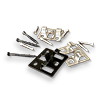
Clip systems are the most common method for installing grooved-edge composite boards. A clip—made of stainless steel or PP plastic—slides into the groove on the side of the board and is screwed into the joist below. The clip performs two jobs simultaneously: it holds the board down to the joist, and it automatically creates a consistent spacing gap between boards. This dual function makes clip systems the fastest and most foolproof option available.
When selecting clips, you have two material choices. Stainless steel clips (grades 304 or 316) offer maximum corrosion resistance and load-bearing capacity, making them suitable for coastal, poolside, and commercial applications. PP plastic clips are lighter, less expensive, and provide some elasticity that helps absorb minor joist irregularities. They are a practical choice for inland residential decks with budget constraints. These two options are not interchangeable in performance, so the choice should be made based on environmental conditions, not price alone. For a closer look at cost-effective options, see our range of concealed PP plastic decking clips.
Screw-and-Plug Systems (Solid Board Solution)
For solid (square-edge) boards that lack a factory-cut groove, screw-and-plug systems are the standard solution. The installer drives a screw through the face of the board into the joist, then covers the screw head with a plug made from the same composite material. Because the plug matches the board's color and grain texture, it becomes nearly invisible after installation. This system is not only used for full decks of solid boards; it is also the recommended method for edge boards, starter rows, and any board that requires a custom angle cut where a clip cannot be seated.
Below-Board Fasteners
Below-board fasteners attach from the underside of the board, making them completely invisible from the top surface. They require that the underside of the board be accessible during installation, which usually means the deck is built over a crawl space or an open joist structure. Below-board fasteners offer the cleanest finish possible, but they are more labor-intensive and are rarely used by contractors who need to meet a schedule.
Screw-Only Jig Systems
Screw-only systems rely on a specialized drilling jig to position and angle each screw consistently. The installer drives screws at specific angles into the side of the board, eliminating the need for a groove. These systems are more common in traditional wood decking. For composite boards, verify with the manufacturer whether the jig system is approved; some hollow or thin-walled profiles may not have sufficient material to hold the angled screw.
| System Type | Board Compatibility | Visual Result | Relative Labor Cost |
|---|---|---|---|
| Clip Fasteners | Grooved-edge boards | Hidden, uniform gaps | Low |
| Screw-and-Plug | Solid boards, edge boards | Hidden after plugging | Medium |
| Below-Board | Any board with accessible underside | Fully invisible | High |
| Screw-Only Jig | Wood, select composite profiles | Visible or invisible by angle | Medium-High |
Grooved vs. Solid Boards: Which Fastener Fits Your Decking?
The single most important compatibility question is whether your deck boards have a grooved edge or a solid square edge. This determines your fastening options before any other consideration.
Grooved-edge boards are designed with a routed channel on both sides, specifically engineered to accept clip fasteners. Co-extrusion decking, deep-embossed boards, and many hollow profiles in the market use this design. If you have selected a co-extrusion decking collection, you can typically use clip fasteners across the entire field of the deck, reserving screw-and-plug or starter clips only for the first and last boards.
Solid boards (square-edge) do not have the groove, so clip fasteners cannot grip the board edge. For these boards, screw-and-plug systems are the primary choice. It is also worth noting that some deep-embossed solid boards can be used with clips if a field-cut groove is created, but this requires a router with a specific bit and is generally not recommended for large installations.
Hollow boards require special attention. Because the internal wall thickness is thinner than that of a solid or co-extrusion board, the fastening point must align with the integral structural ribs of the board profile. Always follow the manufacturer's spacing specification to avoid compressing the hollow core or causing a visible dimple on the deck surface.
How Joists and Fasteners Work Together: The Complete Fastening System
The fastening system does not end with the clip or screw. It includes the entire load path from the deck board down to the joist structure. The spacing and material of the joists directly control how much stress reaches each fastener point.
For residential composite decks, joist spacing should be between 400 mm and 600 mm on center. When joist spacing exceeds this range, the unsupported board span increases, and the concentrated load at each clip becomes excessive. This can lead to clip deformation or board deflection over time. The result is a bouncy deck and prematurely worn fasteners.
The joist material also matters. WPC decking joist options give you a consistent material profile that matches the thermal expansion behavior of composite deck boards. WPC joists are resistant to moisture rot and insects, and they provide a flat, even surface for fastening. Aluminum joists are another option; they are lightweight and completely rot-proof, but require self-tapping screws and silicone washers to prevent galvanic corrosion when used with stainless steel clips. Wood joists are still common, but they introduce a variability in screw holding power that can compromise the long-term reliability of the clip attachment.
A complete fastening system for a professional installation includes five components: the clips or fasteners, the matching screws, starter clips for the first row, edge trim for the last row, and—where necessary—an adjustable plastic pedestal system for leveling on uneven ground. Ordering all components from a single manufacturer eliminates the guesswork of material compatibility and ensures that each element is designed to work with the others.
Comparing Clip Materials: Stainless Steel vs. PP Plastic
Within the category of clip fasteners, the material choice of the clip itself is a critical decision. You will find two dominant materials: stainless steel and PP plastic. They differ significantly in structural strength, corrosion resistance, and cost.
Stainless steel clips (commonly grade 304 or 316) offer the highest level of structural integrity. They will not corrode in marine environments, and they maintain their spring tension over decades of thermal cycling. For coastal decks or poolside projects where chlorine and salt are present, stainless steel is strongly recommended. The superior mechanical properties also mean they are a better match for heavy commercial traffic. If this fits your project environment, consider investing in premium stainless steel decking clips, which are designed for easy installation and long service life.
PP plastic clips, by contrast, are engineered to offer a cost-effective solution for moderate climates. They provide adequate holding strength for residential decks in inland areas, are immune to corrosion by nature, and their slight flexibility makes them forgiving if the joist surface is not perfectly flat. However, PP clips have two notable limitations. They are more vulnerable to becoming brittle in extreme low-temperature environments (below -20°C), and prolonged exposure to high-UV regions may cause the material to degrade over a 10–15 year horizon. For a budget-conscious project in a dry, shaded, or temperate location, PP clips present a reasonable trade-off.
The practical takeaway is: choose steel when you want maximum durability and are working in a demanding environment; choose PP when cost is a priority and the exposure conditions are mild.
Installation Tips for a Flawless Hidden-Fastener Deck
Once you have confirmed the correct fastener type for your board, the installation technique will determine the final quality. The standard sequence for a grooved-edge deck using hidden clips is as follows:
- Set the starter board. The first board must be secured using stainless steel starter clips on the joist. This clip aligns the leading edge and provides the foundation for the spacing of all subsequent boards.
- Place the full-width clips. Position a clip in the groove of the installed board at each joist location, and secure it with the specified screw.
- Slide the next board into place. Push the next board firmly against the installed row until the grooves seat completely on the protruding clips.
- Tap and lock. Use a rubber mallet to gently tap the board into final position. This ensures the board is fully seated. Do not use a metal hammer—it will dent the board surface. Never over-tighten screws, as this can pull the board down and cause a low spot or a slight lip at the seam.
- Repeat and check. Continue the sequence, but verify the gap consistency every five rows. The gap should be uniform along the entire length of the board to allow proper drainage and expansion.
A common error is to fasten hollow boards without confirming the rib location. Screws must always penetrate the solid rib; if the screw is placed into the hollow cavity, the clip will not grip, and the board will eventually work loose. On larger projects, mark the joist locations on the board surface with chalk before starting each row to ensure accurate screw placement.
Which Fastening System Should You Choose? A Decision Guide
The information above can be consolidated into a practical decision framework. Work through these three checks in order, and you will arrive at the correct fastening system for your project.
Check 1: Board Type. Is your board grooved-edge? If yes, use clip fasteners. Is it solid/square-edge? If yes, use screw-and-plug. Is it a mix of both? This happens often with pattern decks or edge boards. The solution is a hybrid strategy: use clips for the main field and screw-and-plug for the few non-grooved or cut pieces.
Check 2: Environment. Is the deck within 5 miles of the coast, or is it directly adjacent to a pool or saltwater? If either is true, specify stainless steel clips with grade 316 for maximum safety. If the project is inland and the climate is dry, PP plastic clips will serve the purpose well and reduce initial material cost.
Check 3: Project Scale and Sourcing. For a contractor or distributor planning multiple projects, it is inefficient to source boards, clips, starters, trim, and joists from different suppliers. Sourcing from a single manufacturer that produces the complete system—deck boards, fasteners, and joists—simplifies logistics and ensures compatibility by design. It also gives you a single point of responsibility if any performance issue arises.
Conclusion: Build It Right with the Right Fastening System
The fastening system you choose determines how the deck looks on day one and how it performs in year fifteen. Matching the correct system to your board type and environment is not difficult, but it does require clear understanding of the trade-offs. Start with the board profile (grooved vs. solid), then consider the environment (corrosion risk), and finally optimize for your installation speed and budget.
For additional guidance, review our complete decking fasteners collection, which includes clips, starter clips, screws, and edge trim designed as one coherent system. For large distributor or contractor projects, a full package—including deck boards, joists, and fasteners—saves time, reduces compatibility risk, and often improves pricing. The right fastening system is not the most visible part of your deck, but it is the most responsible part.
Tin tức của chúng tôi //
Tin tức liên quan
-
Email: [email protected]
Email: [email protected] -
Tel: +86 13732382108
Tel: +86 18705821696 -
 BLDG#1, KHU CÔNG NGHIỆP SINH THÁI LONGOUANWU, MIAOXITOWN, QUẬN WUXING. HỒ CHÂU. TRUNG QUỐC
Liên kết nhanh
Trung tâm sản phẩm
Bản quyền © 2025 Huzhou Baosheng New Material Co., Ltd.Mọi quyền được bảo lưu.
